Tags :
purchasing services
Sourcing agents
Struggling with rising procurement costs, wasteful spend, and unstable supplier pricing? Explore the top 25 actionable procurement cost reduction strategies
Procurement cost reduction is not just about paying less for goods and services. It is about improving buying discipline, reducing waste, strengthening supplier performance, and making every purchase more strategic.
For B2B companies, the biggest savings often come from better process control rather than aggressive price negotiation alone. That is why the most effective procurement programs combine supplier management, demand planning, analytics, and contract discipline.
Why procurement costs rise?
Common drivers include:
- Too many suppliers buying the same category.
- Poor visibility into spend by department or location.
- Emergency purchases created by weak demand planning.
- Outdated contracts with unfavorable terms.
- Maverick spending outside approved procurement channels.
Why These 25 Strategies Outperform Random Cost-Cutting Tries
Unlike one-off price haggling that only brings short-term trivial savings, this full set of strategies covers every core link of procurement operations, from supplier management, process optimization, data application to supply chain layout. Industry data shows that enterprises that fully implement these measures can reduce comprehensive procurement costs by 28% to 42% on average within 6 months, while cutting emergency order delays by more than 60%.
Effective procurement cost reduction is not simply cutting budgets—it is standardized, data-driven, and strategic optimization of the entire purchasing, supplier, inventory, and logistics workflow. A mature procurement cost control system can directly reduce overall enterprise costs by 10%–30% while improving supply chain stability, supplier quality, and order fulfillment efficiency.
Full Breakdown of the 25 Procurement Cost Reduction Strategies
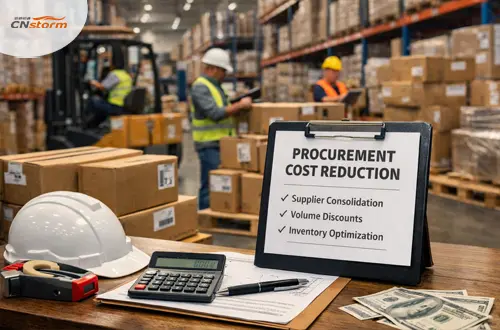
- Consolidate Suppliers
Primary Objective: Reduce supplier base
Key Benefit: Cut redundant management costs, gain stronger negotiation leverage, and build deeper, more stable cooperative relationships with core suppliers, which can bring an extra 10% to 15% preferential space on the basis of original quotations.
- Implement Strategic Sourcing
Primary Objective: Optimize supplier selection
Key Benefit: Avoid the risk of choosing low-price but unqualified suppliers, realize long-term cost savings of more than 20% in the whole procurement cycle, and tap additional value-added services such as after-sales support and customized solutions from suppliers.
- Negotiate Long-Term Contracts
Primary Objective: Secure stable pricing
Key Benefit: Effectively hedge the impact of raw material price fluctuations and market supply shortages, lock in stable supply channels, and get more favorable payment terms and priority delivery guarantees.
- Conduct Spend Analysis
Primary Objective: Understand spending patterns
Key Benefit: Dig out hidden scattered expenditure, repeated procurement and unnecessary consumption links that are ignored in daily operations, and usually find 15% to 25% of untapped savings opportunities in the first analysis.
- Leverage Volume Purchasing
Primary Objective: Increase buying power
Key Benefit: Merge scattered small orders to reach the bulk discount threshold, directly reduce unit purchase cost by 12% to 30%, and reduce the extra cost caused by multiple small batch transportation.
- Optimize Total Cost of Ownership (TCO)
Primary Objective: Evaluate lifecycle costs
Key Benefit: Avoid the trap of "low unit price but high later maintenance, failure and replacement cost", make more scientific procurement decisions, and reduce the comprehensive use cost of goods by more than 35% in the whole life cycle.
- Introduce Competitive Bidding
Primary Objective: Encourage supplier competition
Key Benefit: Break the information monopoly of single supplier, push suppliers to actively optimize their own cost structure, reduce procurement cost by 10% to 22%, and get higher product quality and service level.
- Automate Procurement Processes
Primary Objective: Reduce manual work
Key Benefit: Cut the manual operation time of order processing, document review and approval by more than 70%, reduce human error rate, and lower the labor cost of procurement teams by 25% on average.
- Improve Demand Forecasting
Primary Objective: Align purchasing with demand
Key Benefit: Greatly reduce excess inventory backlog and emergency rush orders with high premium, cut inventory overstock loss by 40%, and eliminate the extra cost of expedited procurement.
- Standardize Products and Specifications
Primary Objective: Reduce variation
Key Benefit: Avoid the cost increase caused by customized non-uniform products, reduce inventory SKU quantity, and lower the comprehensive cost of procurement, storage and after-sales maintenance by 18% to 28%.
- Strengthen Supplier Relationship Management
Primary Objective: Build supplier partnerships
Key Benefit: Promote suppliers to participate in product optimization and process improvement, launch joint cost-saving projects, and achieve shared cost reduction benefits that cannot be obtained in pure transactional cooperation.
- Reduce Maverick Spending
Primary Objective: Improve purchasing compliance
Key Benefit: Eliminate unapproved private procurement outside the formal process, bring all expenditure under unified control, and usually recover 8% to 15% of unnecessary lost costs.
- Adopt E-Procurement Platforms
Primary Objective: Digitize procurement workflows
Key Benefit: Realize full traceability of procurement data, transparent comparison of supplier quotations, greatly improve process efficiency, and reduce the comprehensive operating cost of procurement links by more than 20%.
- Evaluate Alternative Suppliers
Primary Objective: Benchmark market options
Key Benefit: Regularly compare the performance and quotation of new suppliers in the market, avoid being locked in by long-term cooperative suppliers with gradually uncompetitive prices, and continuously optimize the overall cost performance of the supply system.
- Optimize Inventory Management
Primary Objective: Control stock levels
Key Benefit: Reduce redundant inventory occupation of funds, cut storage, depreciation and scrap costs, and reduce the overall inventory carrying cost by 22% to 35%.
- Utilize Global Sourcing Opportunities
Primary Objective: Access international suppliers
Key Benefit: Make full use of the comparative advantages of different regional industrial chains, find suppliers with higher cost performance, and reduce the procurement cost of raw materials and standard parts by more than 25%.
- Bundle Procurement Requirements
Primary Objective: Combine purchasing needs
Key Benefit: Merge procurement demands of different departments and different categories, form larger order scale, gain greater negotiation leverage, and win more exclusive preferential policies from suppliers.
- Implement Category Management
Primary Objective: Manage spend strategically
Key Benefit: Arrange dedicated personnel to conduct in-depth research on each procurement category, formulate targeted cost reduction plans, and achieve category-specific savings of 15% to 30%.
- Conduct Regular Supplier Performance Reviews
Primary Objective: Monitor supplier effectiveness
Key Benefit: Timely identify suppliers with declining quality, delayed delivery and uncompetitive prices, dynamically optimize the supply system, and realize continuous improvement of quality, delivery and cost control.
- Use Data Analytics for Procurement Decisions
Primary Objective: Improve decision-making
Key Benefit: Dig out hidden inefficiencies and potential savings opportunities from massive historical procurement data, avoid blind decision-making relying on experience, and make cost reduction measures more targeted and predictable.
- Minimize Expedited Shipping
Primary Objective: Improve planning
Key Benefit: Reduce the extra premium of urgent logistics caused by insufficient advance planning, cut the comprehensive logistics cost of procurement links by 10% to 20%, and avoid the risk of supply interruption caused by logistics delays.
- Explore Nearshoring and Regional Sourcing
Primary Objective: Reduce supply chain distance
Key Benefit: Shorten transportation distance, reduce cross-border logistics costs and customs clearance risks, cut the overall supply chain response cycle by more than 50%, and reduce the comprehensive cost of long-distance cross-border procurement.
- Collaborate with Suppliers on Cost Reduction
Primary Objective: Improve operational efficiency
Key Benefit: Jointly optimize production processes, reduce redundant links, realize shared cost savings, and achieve a win-win situation where both you and suppliers reduce costs and increase efficiency.
- Review Contract Terms Regularly
Primary Objective: Maintain competitive agreements
Key Benefit: Timely clear outdated unreasonable terms, hidden fees and non-competitive clauses in old contracts, prevent unnecessary hidden costs, and keep the agreement terms always in line with the latest market level.
- Outsource Procurement Functions
Primary Objective: Access external expertise
Key Benefit: Make use of the professional experience, supplier resources and scale advantages of third-party professional procurement service providers, reduce the operating cost of building a full procurement team, and achieve more than 20% of cost savings without additional team expansion.
3-Stage Implementation Roadmap to Avoid Blind Cost-Cutting Risks
Many enterprises fail to get expected savings because they implement all strategies at one time, which leads to supply chaos. You can arrange the promotion in stages according to the actual situation of your enterprise:
- Stage 1 (0-3 months, quick win): Prioritize strategies with low implementation threshold and immediate effect, including spend analysis, reduce maverick spending, consolidate suppliers, conduct competitive bidding, you can quickly achieve 10% to 15% of cost savings in the short term.
- Stage 2 (3-9 months, system optimization): Promote process digitization, demand forecasting, TCO evaluation, category management and other measures, build a standardized procurement operation system, and further increase the total savings to 25% to 30%.
- Stage 3 (9-18 months, long-term value): Deeply carry out strategic sourcing, supplier collaborative cost reduction, global and nearshoring layout, form a core competitive advantage that peers cannot replicate, and lock in long-term stable low-cost operation.
If you want to get a customized procurement cost reduction plan that matches your industry and enterprise scale, you can contact our professional procurement consulting team, we will help you sort out your existing expenditure structure for free, and tap the exclusive savings opportunities suitable for your business.
How Cnstorm Helps Enterprises Implement Procurement Cost Reduction
As a professional global sourcing service provider, Cnstorm empowers corporate procurement cost optimization through one-stop supply chain solutions, helping you efficiently land the above 25 cost reduction strategies:
- Global supplier resource integration: Integrate high-quality global suppliers to support competitive bidding, global sourcing, and supplier consolidation, lowering procurement unit prices
- Data-driven spend management: Provide real-time procurement data analysis and demand forecasting to eliminate blind purchasing and inventory waste
- Digital procurement & warehousing system: Realize automated process management, reduce manual costs, and improve procurement compliance
- Integrated logistics optimization: Optimize transportation routes, avoid expedited shipping fees, and support nearshoring & regional sourcing to cut logistics costs
- Professional outsourcing services: Provide standardized procurement and supply chain operation services to help enterprises reduce labor and management costs
Through systematic procurement optimization + intelligent warehousing + efficient global logistics, we help customers reduce comprehensive supply chain costs by 15%–30% steadily.
Frequently Asked Questions (Procurement Cost Reduction)
1. Which procurement cost reduction strategies are the most effective for SMEs?
For small and medium-sized enterprises with limited resources, priority should be given to low-cost and high-return strategies: spend analysis, demand forecasting optimization, supplier consolidation, volume purchasing, and maverick spending control. These methods require no large investment and can quickly generate cost-saving benefits.
2. What is the difference between TCO optimization and simple price negotiation?
Simple price negotiation only reduces the purchase unit price, while TCO (Total Cost of Ownership) optimization considers the full life cycle cost including procurement, transportation, storage, after-sales maintenance, and loss waste, which can achieve more scientific and long-term cost control.
3. How to avoid risks while reducing procurement costs?
Cost reduction cannot sacrifice quality and delivery stability. It is necessary to match supplier performance evaluation, pre-shipment inspection, contract term restraint, and demand planning optimization to ensure cost reduction while stabilizing supply chain quality and efficiency.
4. Is outsourced procurement suitable for cross-border trading companies?
Yes. Professional outsourced procurement teams have mature global supplier resources, standardized processes, and data analysis capabilities, which can help cross-border enterprises avoid operational blind spots, reduce labor costs, and improve the overall competitiveness of procurement business.
 RECENT POSTS
 86-0579-85571695
 support@cnstorm.com
 Monday to Saturday
9:00-12:00 13:30-18:30(Beijing time)
Sunday : closed
Monday to Saturday
9:00-12:00 13:30-18:30(Beijing time)
Sunday : closed





 Previous

 CN - Shenzhen Warehouse
 Announcement of 2019 Spring Festival Holiday