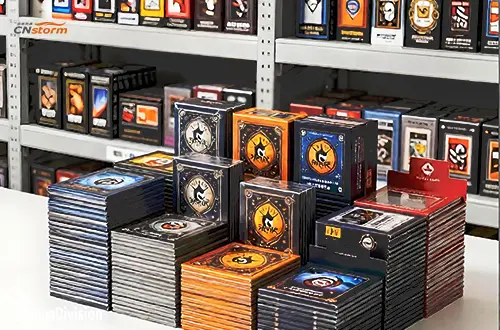
To source card games from China, create a complete product specification, shortlist experienced card-game factories, approve a physical pre-production sample, confirm safety and compliance requirements, inspect production before shipment, and use a fulfillment partner that can store and ship inventory to DTC customers, Amazon, TikTok Shop, and wholesale buyers.
The highest-risk errors happen before bulk production begins: unclear card count, wrong card stock, inconsistent artwork files, weak packaging, incorrect age grading, missing safety testing, or a factory that cannot match colors and finish at scale.
Card games and printed tabletop products are commonly sourced from printing and game-product clusters in Guangdong, Zhejiang, Fujian, Shanghai, and other established paper-product regions in China. Guangdong and Zhejiang are frequent starting points for card games because factories in these areas often combine printing, paper conversion, packaging, assembly, and export capability.
| Region | Typical Strength |
|---|---|
| Guangdong | Export-oriented manufacturers, premium packaging, game components, assembly, fulfillment access |
| Zhejiang | Paper products, playing cards, packaging, cost-efficient production |
| Fujian | Paper printing, educational products, packaging components |
| Shanghai / Jiangsu | Premium printing, higher-specification packaging, product development support |
| Shenzhen / Dongguan | Product assembly, electronics, timers, LED or battery components for hybrid games |
| Yiwu | Small accessories, tokens, promotional add-ons, bundled components |
Sourcing insight: The “best” factory is not necessarily the factory with the lowest deck price. The best choice is the one that can consistently make your exact card stock, finish, packaging, and compliance requirements at your expected reorder volume.
Typical card-game MOQs range from about 500 to 2,000 units, though highly customized games, premium rigid boxes, unusual card sizes, specialty finishes, or mixed components can require higher quantities. Digital or short-run printing may support lower volumes, but unit costs are generally higher.
| Product Type | Typical MOQ Range | Main Cost Driver |
|---|---|---|
| Standard playing-card deck | 500–1,000 units | Print run, card stock, tuck box |
| Custom party-card game | 500–2,000 units | Card count, artwork, packaging |
| Educational children’s card game | 1,000–3,000 units | Testing, packaging, age-grade requirements |
| Premium tarot/oracle deck | 500–1,500 units | Thick card stock, foil, rigid box, guidebook |
| Trading-card booster pack | 1,000+ packs | Collation, wrappers, rarity sorting, packaging |
| Card game with dice/tokens | 1,000–3,000 units | Component sourcing, assembly, insert tray |
| Card game with electronic component | Often 2,000+ units | Tooling, batteries, electronics testing, assembly |
Practical recommendation: Start with the MOQ that gives you enough stock to learn, but not so much that you are forced to discount old inventory before your second production run.
A typical card-game sample takes about 14 days from a complete factory brief, while bulk production usually takes about 30–50 days after sample approval. The actual calendar can be longer when artwork changes, packaging is customized, safety testing is required, factories are near holiday closures, or freight capacity is limited.
| Stage | Typical Timing | What Can Extend It |
|---|---|---|
| Factory matching and quotation | 3–10 business days | Incomplete brief, unusual materials, multiple components |
| Artwork preflight and proofing | 3–10 business days | Missing bleed, image-resolution issues, color corrections |
| Physical sample | About 14 days | Custom mold, rigid box, foil, unusual component sourcing |
| Sample review and revisions | 3–14 days | Card feel, color, rules changes, packaging changes |
| Product-safety testing | Varies by product and target market | Children’s classification, lab queue, retesting |
| Mass production | About 30–50 days after approval | Volume, finishing, assembly, peak season |
| Pre-shipment inspection | 1–3 days | Rework needed after QC findings |
| Air freight to US warehouse | Often 5–8 days in transit | Destination, customs, carrier capacity |
| Sea freight | Quote-specific | Port congestion, sailing schedule, inland delivery |
For crowdfunding campaigns, holiday sales, influencer launches, or marketplace promotions, work backward from the date stock must be available at the warehouse—not the day the factory finishes production.
Choose a card-game factory based on proven category capability, transparent quoting, sample quality, print consistency, quality-control system, component sourcing ability, compliance support, and communication—not only the lowest price.
| Question | Why It Matters |
|---|---|
| Does the factory regularly make card games, not just brochures or generic packaging? | Card shuffling, opacity, die cutting, collation, and tuck-box construction require specific experience |
| Can it show comparable projects? | Confirms it has handled similar stock, finish, and packaging |
| Does it own or control the key printing, die-cutting, and assembly process? | Reduces hidden subcontracting risk |
| Can it provide paper, ink, coating, and packaging specifications? | Prevents vague material substitutions |
| Can it produce a physical sample before bulk order? | Lets you test quality before committing |
| Can it explain defect-control methods? | Reveals whether it tracks print, cut, pack, and count errors |
| Can it support required testing or provide material declarations? | Important for children’s and regulated products |
| Can it meet your target delivery date? | Prevents a factory from winning the order with an unrealistic promise |
| Does its quotation separate card, box, components, assembly, tooling, and packaging cost? | Makes comparison possible |
| Can it provide export-ready cartons and documentation? | Reduces freight and customs surprises |
Below is a table without CSS styling. Please center the table, set the overall border to a 1px solid black line, adjust the line height to make it less cramped, and ensure it is mobile-friendly. Then, output the modified HTML code.
| Packaging Type | Best For | Fulfillment Consideration |
|---|---|---|
| Tuck box | Standard decks, lightweight products | Cost-effective, easy to pack |
| Rigid setup box | Premium card games, gift products | Better unboxing; higher weight and cost |
| Magnetic closure box | Collector editions | Requires strong corner protection |
| Tin box | Durable travel or gift products | Heavy; can dent in transit |
| Shrink wrap | Tamper evidence and retail presentation | Confirm plastic and market requirements |
| Paper belly band | Low-cost branding or bundle control | Can shift or tear during fulfillment |
| Molded tray | Multi-component games | Prevents component movement but increases packaging complexity |
ChinaDivision perspective: Packaging should be designed for warehouse handling and carrier movement, not only retail display. A beautiful rigid box that corners easily in transit can create avoidable returns and marketplace complaints.
A card game is sample-ready when every printable component, material choice, packaging detail, count, language version, and approval standard is defined in writing. Factories cannot manufacture reliably from a concept description alone.
| Inspection Area | What to Check |
|---|---|
| Card count | Correct number of cards in each deck and box |
| Artwork | Correct card faces, backs, rule cards, versions, and language |
| Print color | Matches approved proof or sample within agreed tolerance |
| Registration | Front/back alignment, borders, cut lines, and no off-center printing |
| Card cutting | Uniform size, smooth edges, correct corner radius, no burrs |
| Card stock | Correct core, thickness, stiffness, opacity, and finish |
| Shuffle performance | Cards do not stick, crack, warp, or transfer ink excessively |
| Coating | No uneven gloss, scratches, peeling, fingerprints, or blocking |
| Packaging | Correct tuck-box closure, rigid-box structure, inserts, and shrink wrap |
| Components | Correct dice, tokens, timer, board, score pad, or accessories |
| Barcode and labels | Correct barcode, scannable placement, age warnings, country of origin |
| Carton pack | Correct units per carton, carton labels, dimensions, and gross weight |
| Drop/transport readiness | Packaging protects cards and boxes from corner crush and movement |
Inspect card games before shipment by checking component counts, card cutting, print color, alignment, coating, packaging, functional elements, labels, and carton condition against an approved sample and written quality checklist. The best inspection compares bulk production to the signed approval sample—not to general expectations.
 RECENT POSTS

 86-0579-85571695
 support@cnstorm.com
 Monday to Saturday
9:00-12:00 13:30-18:30(Beijing time)
Sunday : closed





 Previous
 CN - Shenzhen Warehouse
 Announcement of 2019 Spring Festival Holiday